Donald R. McClarey
Cradle Catholic. Active in the pro-life movement since 1973. Father of three, one in Heaven, and happily married for 43 years. Small town lawyer and amateur historian. Former president of the board of directors of the local crisis pregnancy center for a decade.
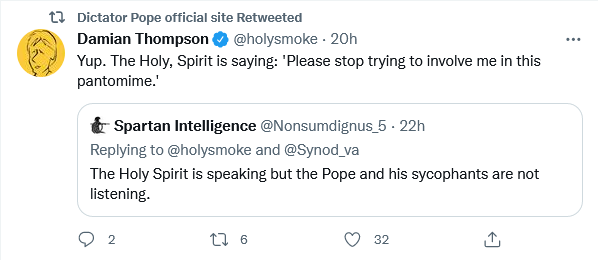



I’ve noticed that the soundness of a person’s religious argument has an inverse relationship with the number of times that the name of the Holy Spirit is invoked. There is a Commandment against taking God’s name in vain. Such abuse of the name of the Holy Spirit is deserving of a defamation lawsuit.
Sin – blasphemy – against the Holy Spirit is unpardonable. This is a very important topic, but there us more to it.. Attributing to God the works of Satan, or doing the works of Satan in the name of God, directly violates the commandment, “Thou shalt not take the name of the Lord thy God in vain; for the Lord will not hold him guiltless that taketh his name in vain.” (Exodus 20:7 and Deuteronomy 5:11) Murdering in God’s name is taking His name in vain. Appointing a pro-abort to the Pontifical Academy of Life is collusion in such murder. In 2021 I wrote the following essay on my old FB page which explains this. My apologies for being longwinded, but sometimes truth cannot be distilled into a simple meme.
THE UNFORGIVEABLE SIN
Readers here will recall that an orthodox Jew by the name of Dennis Prager runs what is called “Prager University,” a conservative nonprofit organization that is focused on changing minds against neo-paganism, post-modernism and for traditional Judeo-Christian values through the use of digital media. Many of you may have watched YouTube videos from Prager University. What you may not know is that Mr. Prager has written a series of books entitled “The Rational Bible,” explaining the Torah (what Christians call the Pentateuch) which is the first five books in the Christian Old Testament. I have purchased two of these books, one on Genesis and the other on Exodus. The commentary given by Mr. Prager is absolutely outstanding and with some exceptions, I find myself more often than not agreeing with his explanations. I encourage everyone – Catholic, Orthodox, Protestant and Jew, to avail yourselves of this man’s insight.
Yesterday I was reading Mr. Prager’s explanation of the Ten Commandments (side note: our Blessed Lord did NOT repeal these in the New Covenant but actually made compliance stricter). His commentary on the prohibition against taking the Lord’s name in vain is most noteworthy and reminded me of Jesus’ declaration that blasphemy of the Holy Spirit – that is, attributing to the devil what is the work of God as the Pharisees did what they said that Jesus casted out demons by the power of Beelzebub – was the unforgiveable sin. Most of us Christians are aware of what Jesus stated in Matthew 12:31-32 and Mark 3:2-29. The Matthean account is given below.
31 Therefore I tell you, every sin and blasphemy will be forgiven people, but the blasphemy against the Spirit will not be forgiven. 32 And whoever speaks a word against the Son of Man will be forgiven, but whoever speaks against the Holy Spirit will not be forgiven, either in this age or in the age to come.
Dennis Prager’s insight on Exodus 20:7 from a totally Jewish perspective (remember, Jesus was a Jew) bears directly on Matthew 12:31-32 and Mark 3:2-29. Therefore, without further delay, here is the pertinent text:
Is there such a thing as the worst sin?
Apparently, there is. And this is it.
How do we know? Because it is the only one of the Ten Commandments whose violation God says He will not forgive-“the Lord will not hold him guiltless” (literally, “God will not cleanse” the one who violates this commandment).
But this immediately raises a question as obvious as it is troubling: Why, of all sins, would a moral and just God say the only person He will not forgive is one who takes His name in vain? What kind of God is prepared to potentially forgive stealing, giving false testimony, possibly even murder but not forgive saying God’s name for no important reason? Is murder potentially forgivable, but saying, “Oh God, did I have a tough day today not forgivable?
Obviously, this cannot be.
And, indeed, it is not.
For one thing, the word “God” is not God’s name. So, saying something like “God, did I have a tough day today” does not violate this commandment. “God” is God’s title. But God’s name is YHVH (we do not know exactly how it is pronounced, and Jews refrain from pronouncing it). It is this name (in the Hebrew original) we are forbidden to say in vain.
But the ultimate, and far more important, reason this sin is unforgiveable is due to something else, which can only be understood if we translate the verb of this commandment literally. Do not “take” is not what the commandment actually says. The Hebrew verb in the commandment, tisa, means “carry.” The commandment therefore reads, “Do not carry God’s name in vain.”
And who carries God’s name in vain? Any person who claims to be acting in God’s name while doing the opposite of what God wants-evil. Obvious modern examples would include Islamist terrorists who shout, Allahu Akbar God Is the Greatest”) when they murder innocent people; or a priest or any other clergy who, utilizing the respect engendered by his clerical status, molests a child. There is little question Islamist terrorists and molesting clergy have both played a role in the rise of atheism in our time.
When any person commits evil, it reflects badly on the person. But when a person commits evil in God’s name, it reflects badly on God as well. The result is the only solution to evil-God-based morality-is thoroughly undermined. When associated with evil, God and ethical monotheism are thoroughly discredited. And that is unforgivable, as it dramatically reduces the chances of creating a good world.
No atheist activist is nearly as effective in alienating people from God and religion as are evil “religious” people.
As noted, the Hebrew word y’nakeh (“hold guiltless”) literally means cleanse.” Essentially God is saying if anyone dirties God’s name, God will never cleanse that person’s name.
When Jesus confronted the Pharisees over their accusation that He performed exorcisms by the power of Satan, the Pharisees were dirtying the name of God and Jesus told them that in no uncertain term. The Pharisees, being as Jewish as Jesus and as Jewish as today’s Dennis Prager knew precisely what Jesus was saying: that they in their sanctimonious piety were violating the commandment against taking the Lord’s name in vain.
That’s really good LQC! I wonder if this falls along the same line as: “Not everyone who says to me, ‘Lord, Lord,’ will enter the kingdom of heaven, but only the one who does the will of my Father in heaven.”
LQC, thanks for the excellent and very informative comment above.